
|
Size: 1706
Comment:
|
Size: 2394
Comment: converted to 1.6 markup
|
| Deletions are marked like this. | Additions are marked like this. |
| Line 1: | Line 1: |
| {{attachment:mrclogo.gif}} |
|
| Line 3: | Line 5: |
| Below you'll find a short description of magnetometers and gradiometers, as well as our MEG sensor and EEG electrode layouts. MEG figures from the Elekta Neuromag System Hardware User's Manual. |
Below you will find a short description of [[#Magsgrads|magnetometers and gradiometers]], as well as our [[#MEGsensors|MEG sensor]] and [[#EEGlabels|EEG electrode]] layouts. The [[#Elektamanuals|Elekta manuals]] are at the bottom. Figures are from the Elekta Neuromag System [[attachment:HardwareUser.pdf|Hardware User's Manual]]. |
| Line 7: | Line 13: |
| Our Vectorview systems contains 102 magnetometers and 204 planar gradiometers. Magnetometers consist of a single coil which measures the magnetic flux perpendicular to its surface. Planar gradiometers consist of a "figure-of-eight"-type coil configuration. The measured signal is the difference between the two loops of the "eight", or the spatial gradient. There are two orthogonal planar gradiometers at each location. This arrangement is illustrated in the following figure (black: magnetometer; grey and white: two gradiometers). | Our Vectorview systems contains '''102 magnetometers''' and '''204 planar gradiometers'''. Magnetometers consist of a single coil which measures the magnetic flux perpendicular to its surface. Planar gradiometers consist of a "figure-of-eight"-type coil configuration. The measured signal is the difference between the two loops of the "eight", or the spatial gradient. There are two orthogonal planar gradiometers at each location. This arrangement is illustrated in the following figure (black: magnetometer; grey and white: two gradiometers). |
| Line 9: | Line 15: |
| attachment:MagsGrads.jpg | <<Anchor(Magsgrads)>> {{attachment:MagsGrads.jpg}} |
| Line 15: | Line 22: |
| attachment:SensorLayout.jpg | <<Anchor(MEGsensors)>> {{attachment:SensorLayout.jpg}} |
| Line 17: | Line 25: |
| attachment:SensorLabeling.jpg | {{attachment:SensorLabeling.jpg}} |
| Line 21: | Line 29: |
| attachment:ElectrodeLayout.jpg | <<Anchor(EEGlabels)>> {{attachment:ElectrodeLayout.jpg}} == Elekta Manuals == <<Anchor(Elektamanuals)>> [[attachment:HardwareTechnical.pdf|Hardware Technical Manual]] [[attachment:HardwareUser.pdf|Hardware User's Manual]] [[attachment:DataAcquisition.pdf|Data Acquisition Manual]] [[attachment:StimulusSystem.pdf|Stimulus System Manual]] [[attachment:SensorTuner.pdf|Sensor Tuner Manual]] [[StandardOperatingProcedures|Standard Operating Procedures]] |

The Elekta Neuromag Vectorview System
Below you will find a short description of magnetometers and gradiometers, as well as our MEG sensor and EEG electrode layouts.
The Elekta manuals are at the bottom.
Figures are from the Elekta Neuromag System Hardware User's Manual.
Technical description
Our Vectorview systems contains 102 magnetometers and 204 planar gradiometers. Magnetometers consist of a single coil which measures the magnetic flux perpendicular to its surface. Planar gradiometers consist of a "figure-of-eight"-type coil configuration. The measured signal is the difference between the two loops of the "eight", or the spatial gradient. There are two orthogonal planar gradiometers at each location. This arrangement is illustrated in the following figure (black: magnetometer; grey and white: two gradiometers).
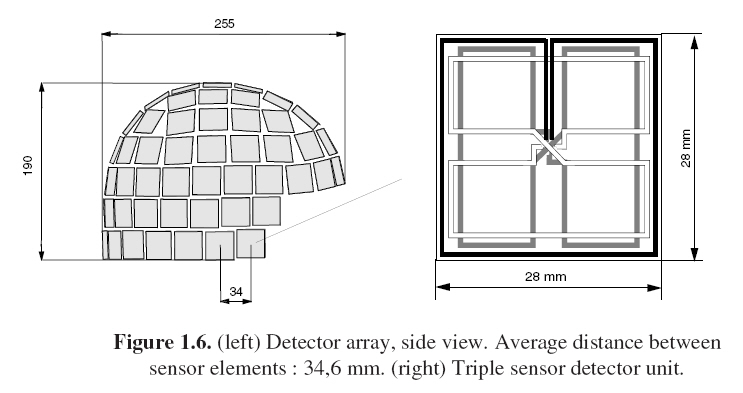
It has been shown that 3 sensors of these types at one location measure independent information (their "leadfields" are orthogonal). It is therefore more efficient than placing 3 sensors of the same type (e.g. magnetometers) close to each other (they would basically measure the same signal 3 times). Our sensor configuration therefore provides an optimal sampling of the magnetic field for a given number of sensors. The downside is that magnetometers and gradiometers often have to be treated differently during analysis or visualisation.
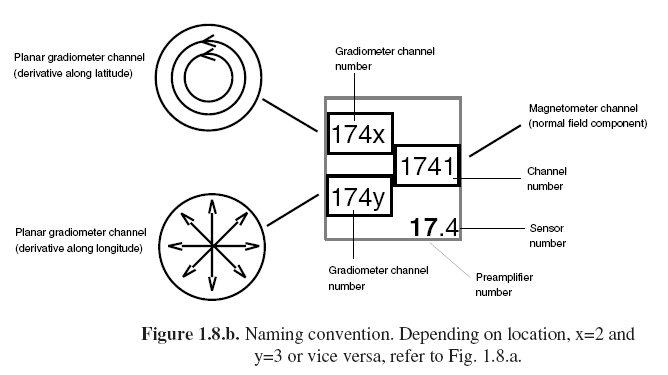
This is the whole sensor layout, including the sensor labels used by the Neuromag software:

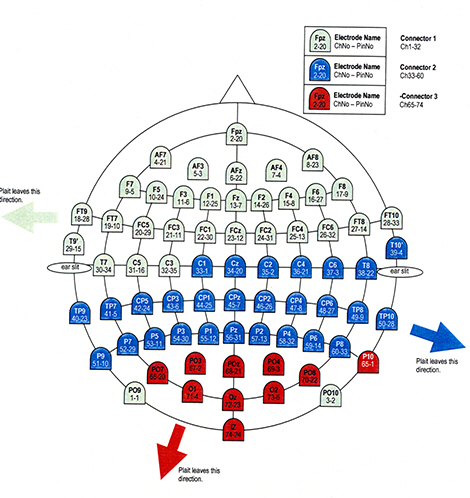
We routinely use a 70-electrode EEG set-up (Easycap) in combination with our MEG recordings. This is the electrode layout:
Elekta Manuals